Building the Week Around the Window
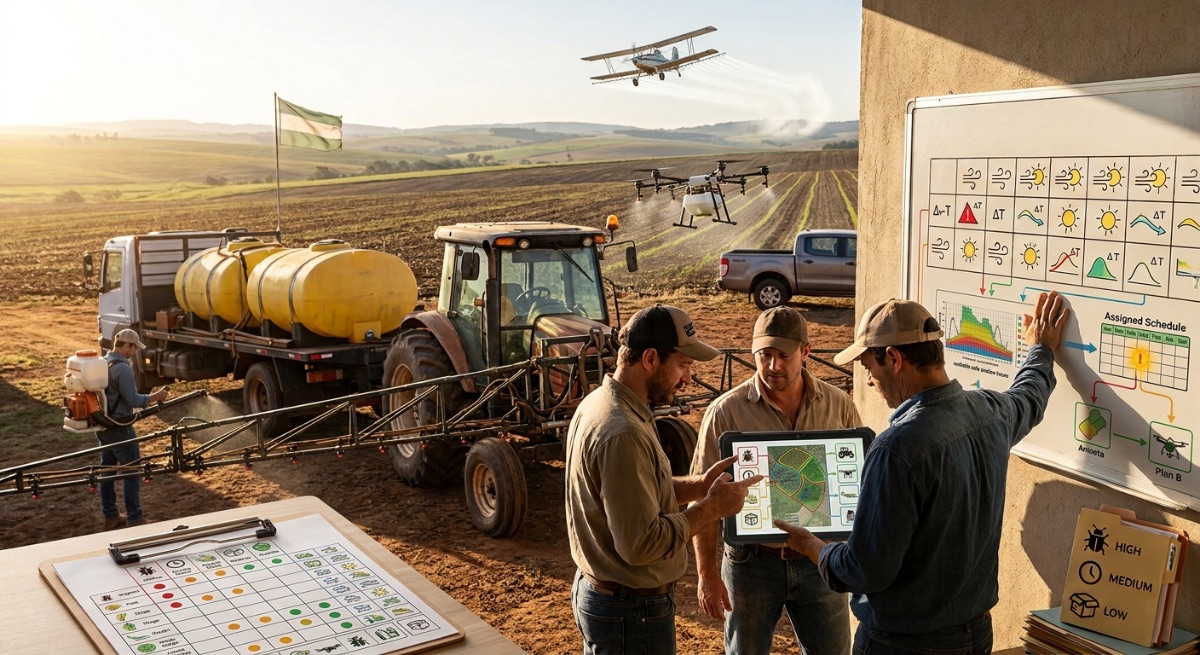
The hardest constraint in a spraying operation is not the equipment and not the staff: it is the hours of the day when the weather allows you to apply properly. Everything else can be bought or hired. Those hours cannot.
And yet, in most operations the schedule is built in the order the calls arrive, which is a criterion with no relationship whatsoever to the hours in which work will actually be possible.
The three constraints that collide
The weather window. Wind within range, no thermal inversion, delta T in the safe zone, no imminent rain. In many regions that is five or six usable hours a day, sometimes split into two blocks: early morning and late afternoon.
Geography. Every move between fields is time taken out of the window. Two neighbouring customers on the same day are worth more than two good customers at opposite ends.
Agronomic urgency. Not every job tolerates waiting equally. A pest at threshold does not wait three days; a preventive treatment does.
The three pull in different directions and you cannot always satisfy all three. What you can do is decide deliberately which one gives.
The method, in three steps
Classify jobs by tolerance to waiting
Before looking at the forecast, every pending job goes into one of three boxes:
- Cannot wait — the biological window closes in days. These take the best hours, no argument.
- Waits a little — a week of slack.
- Flexible — movable at no agronomic cost. This is your filler material for windows that would otherwise go unused.
This classification is made by the agronomist or the grower, not by whoever builds the schedule. And you have to ask for it explicitly: if you ask "when do you need it by?", everyone says "as soon as possible".
Group by area before assigning days
With the jobs classified, group them geographically. The rule: one day, one area. Every time you break it, you pay for the travel with window hours, which are the ones you cannot buy.
When an urgent job falls outside the day's area, the right question is not whether it is worth going: it is whether you can drag some flexible job from that same area along so the trip pays.
Assign against the forecast, with a plan B
Only now does weather enter. The three-day forecast is for ordering the week; the decision to spray is made on the morning itself with real data, because a forecast beyond one day is not fine-grained enough for a window measured in hours.
Hence the rule that saves days: every day should have an alternative field nearby. If the main field wakes up with a crosswind towards the sensitive neighbour, the alternative is a different job in the same area — not going home.
The two blocks of the day. When the window splits into morning and afternoon, it pays to assign them by different criteria: the morning one is usually longer and more stable, and that is where the large jobs go; the afternoon one is short and uncertain, and works better with small nearby fields you can abort without losing much.
Rescheduling without burning the customer
Moving a date for weather is normal and every grower understands it. What they do not forgive is finding out late.
- Confirm on the morning itself. Putting in the agreement that the date is confirmed on the day according to conditions turns rescheduling into procedure, not breach.
- Give the concrete reason. "Wind at 22 km/h towards the neighbouring citrus block" is a technical explanation that builds trust. "Can't do it today" builds doubt.
- Give the new date in the same message. A postponement without a date feels like abandonment.
- Record why it was cancelled. It is the data that next year tells you how many days in March are genuinely sprayable in your area — and that backs your decision if it is ever questioned.
The metric that organises everything. Hours sprayed divided by usable window hours. If you had thirty sprayable hours in the week and worked eighteen, you do not have a demand problem: you have twelve hours that went into travel, setup and waiting. That is the figure you improve on, and it appears nowhere unless you measure it.
What makes this method possible
Everything above needs two things visible at once: the pending jobs with their location and urgency, and the expected conditions. When the schedule lives in a notebook and the weather on a phone, the cross-referencing happens in the owner's head every morning — and it works, until there are three machines and forty pending jobs.
In short: classify jobs by tolerance to waiting, group by area, and only then assign against the forecast — with a nearby alternative field for every day. Confirm on the morning itself, give the technical reason and the new date in the same message, and record every cancellation. At the end of the season you will know whether your limit was demand or logistics.
General guidance only. Acceptable application conditions depend on the product, the equipment and local regulations. Always follow the label.
Sources: University of Nebraska-Lincoln Extension; Penn State Extension; Montana State University Pesticide Education Program.